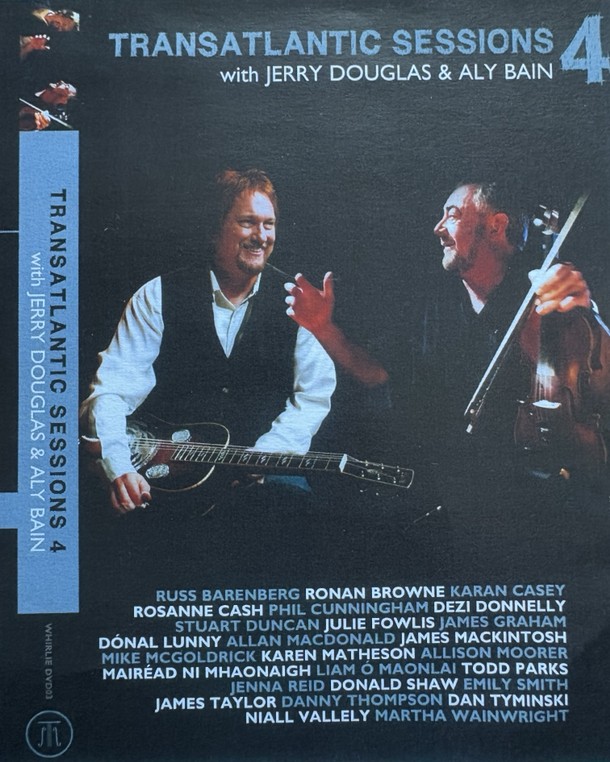
TRANSATLANTIC SESSIONS

TRANSATLANTIC SESSIONS: Black is the colour I usedmost when lighting Transatlantic Sessions’.  It’s a great tool when you’re trying to conceal multiple shadows. 

Transatlantic Sessions is a wonderful music series brought to Pelicula Films by its director, the late Mike Alexander.Pelicula was formed by Mike and I in 1971, and here we were in 2012, still making films. The Transatlantic Sessions series was re-commissioned on six occasions and I was fortunate enough to direct the photography on all thirty six episodes.

Mike’s ability to co-ordinate the musicians on a set, sometimes as many as nine, was legendary and they produced a fabulous sound. According to all accounts the pictures were pretty good too.

Mike would first decide, along with his three camera operators, where the best angles were, not only to film the musicians, but also the scenic magic of Loch Lomond seen through the glass windows behind them. So now we introduce a plethora of reflections, along with the varying intensity of daylight on the other side of the glass.  To control the intensity of the outside daylight, constantly changing from bright sun,to moody black clouds; Derek Ritchie, my gaffer sparks made up three frames to fit each window, enabling us to use different grades of neutral density filters to balance the outside daylight with our inside artificial light.

I invented black key lights to hide the numerous invasiveshadows that naturally appear when lighting the six musiciansin the House Band. There’s also microphones and mic stands, to contend with, all on a cramped set. The sound engineerscreated miracles with the quality of sound they produced frompencil thin mics.

I’m starting with a black canvas and I need six lights permusician to create the pictures that will highlight for the viewer, the intricate skills and wonderful performance of eachartists. Only trouble was that thirty-six lights have the potential to create thirty-six shadows. 

Of course, the black key lights didn’t exist, only in my imagination, but it enabled Derek and I to work out a lighting plan where the shadows would be concealed in the black spaces we created round the artists, using every lighting control available.

At the risk of attracting complete boredom, let me tell you why I need six lights per musician.

For Aly Bain plus fiddle, I’d have a back key light focused on his bowing hand and another back key light on his fingerboard. I would then have a three-quarter back key lightto shape his face and a fourth back light to separate him from the background. These were all positioned first. I would then introduce my soft fill light to see Aly’s face and a soft upwardfloor light to lessen the contrast overall.

What a privilege. Apart from the wonderful House Band, I was lighting such eminence as Emmylou Harris, James Taylor, Alison Kraus, Dougie Maclean, Dick Gaughan, Iris DeMent, Rosanna Cash, Nancy Griffith, Rufus Wainwright,Mary Chapin Carpenter, Julie Fowlis, Allison Moore, Teddy Thompson, the late John Martyn and many more.


So, I called my memoir, Shaping the Shadows: A Picture Maker’s Story’.


Available from the National Library of Scotland(£10)

marklittlewood.org.uk

and Amazon.
2025-12-02T14:04:13+00:00NEWS/BLOG|

The AVENGERS and STUCK in a LIFT

THE AVENGERS and STUCK in a LIFT may seem like strange bedfellows, but both came into my life about the same time – let me explain.

The Avengers, is one of the most successful television series of all time, shown in over ninety countries. They’re stories of espionage and intrigue, starring Patrick Macnee as John Steed, the quintessential English spy, along with various leading ladies Diana Rigg, Honor Blackman and Joanna Lumley. It is one of those superstars that links my stories.

Anyway, I met Patrick Macnee, whilst filming for Robin Crichton at his studios in the lee of the Pentland Hills. Patrick was the first Eton Scholar who came into my life, the second was George Orwell.

In real life Patrick was very similar to the character he played in The Avengers. His special kind of upper-class genialityand charm covered all topics and made him very enjoyablecompany. We talked at length about our shared experience with asthma. Both his daughter Jenny and I have serious asthma problems.


Patrick moved to California in the hope that a dry climate might help Jenny’s breathing. I’d moved from one Industrial centre(Sheffield) to another(Glasgow) taking my asthma and bronchiectasis with me.


Now the connection between ‘The Avengers’ story and the ‘Stuck in a Lift’ Story is Diana Rigg, one of Patrick’s leading ladies.


The multi-talented Andy Park had chosen Diana to feature in a commercial he was producing for a local radio station in London and had asked me to direct the photography.


The morning shoot with Diana was slow due to technical reasons, which meant lunch was also delayed and we were all starving. Normally I took the stairs in fear of the lift, but on this occasion, bribed by hunger, I joined the rest of the crew in the lift .


I pressed the button, nothing happened, then with a loud bangit suddenly dropped about five feet and stuck. We were all full of bravado, thinking mistakenly that our gung-ho attitudewould ease the fear. It didn’t and as time passed, our little box grew very quiet as apprehension seeped in.


Eventually, the fire brigade arrived and we were set free. I concluded that starvation was preferable to being stuck in a lift for two hours.


#TheAvengers #AndyPark #ShapingTheShadowsAPictureMakersstory #EustonFilms


The AVENGERS and STUCK in a LIFT are in my bookShaping the Shadows: A Picture Maker’s Story, along with many others.

For sale from the National Library of Scotland for £10.

Also see: marklittlewood.org.uk

Amazon

2025-11-07T15:57:29+00:00NEWS/BLOG|

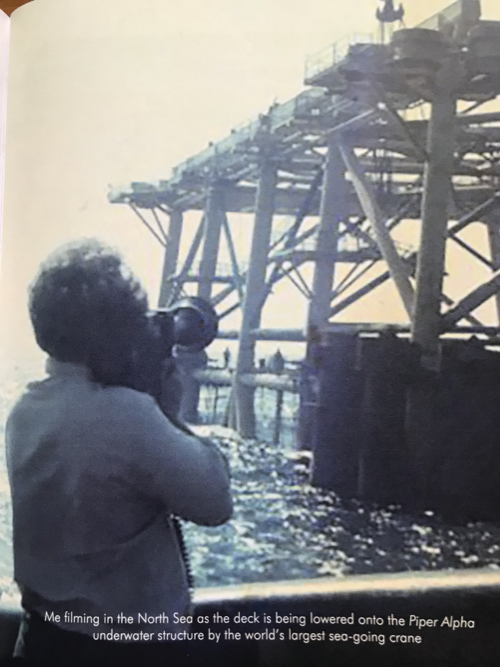
PIPER ALPHA: In the Beginning (1972 – blog 2)

I was terrified by claustrophobia and the fear of drowning. This was frontiersville where the boundaries of health and safety were nonexistent. 

Piper Alpha is still the worlds worst offshore disaster in human history with 167 souls being lost(6th.July 1988)

Through ‘Films of Scotland’ Occidental Oil, the owners of Piper Alpa had heard of my success filming engineeringprogress report’ type films. I’d certainly become an expert in filming concreteThe Building of the Tay Road Bridge withCampbell Harper Films and the making of bricks in Murray Grigor’s, GR Stein film. Now I was being asked to develop a special way to look at steel superstructures.


I was actually filming on the exploration deck when theydiscovered the huge Piper Alpha field(1973). Great excitement, ‘…buy Occidental shares’ went the cry from the roughknecks, before their price rocketed the next day.Unfortunately, my bank manager went home early and failed to make the requested purchase.

After the sub-sea structure was completed at Ardesier It was towed out to the oilfield on a huge barge. I struggle to describe the amazing scene I filmed from the helicopter.  

Sometimes I couldn’t see the barge and it seemed as if this massive structure was floating through the sea unaided.Everything was moving in slow motion as if in a dream. This gargantuan chunk of red metal lying on its side, gliding  abovethe soft white fluffy clouds, as if they were escorting the mother ship to its destination.


Even worse than filming on the Oil platform was filming onpipelaying barges. It was like hell on earth, really cramped,dark, sweaty, noisy places as they prepared to deliver oil to their terminal in Flotta. The pipe came out the sea at one end of the barge, the next section was welded on and it returned to sea at the other.

The only way to access the oil platform, before the helicopter deck was installed, was from the heaving deck of a supply boat. 

A crane high above the sea on the superstructure would lower a horizontal tyre, slung in rope netting. The operator then had to time his actions so that the tyre landed flat on the heaving deck when the sea was at its lowest. Then between myself and the crane operator precise timing was essential. First thecamera equipment had to be placed quickly inside the tyre,through a hole in the net, then I would leap onto the outside of the tyre and clinging on for dear life would be sweptoverboard and out to sea as the crane operator hauled me off the deck with the next rising wave – terrifying but it was producing a healthy income for Pelicula Films. 


#PiperAlpha #Ardersier #earlynorthseaexploration#DoctorHammer #Occidentaloil #PhenominalDanger#Northseahelicopters.


PIPER ALPHA: In the Beginning is in my book ‘Shaping the Shadows: A Picture Maker’s Story along with many others.

For sale from the National Library of Scotland for £10.

See also: marklittlewood.org.uk

Amazon.

2025-10-23T17:30:53+00:00NEWS/BLOG|

SARA: Three Months in Provence (blog 3)

For centuries, Saintes-Maries-de-la-Mer has hosted the World Famous Roma Pilgrimage. It’s a fabulous show full of color and pageantry.
Gypsies come from all over Europe to venerate their Saint. It’s also a time for reunions with family and friends. Many gypsy children are baptized in the ‘Church of the Saintes’
The celebration starts with the statue of Sara being taken from the underground crypt in the Church, it is then lifted on high by the gypsies on horseback and accompanied by Arlesiennes, clothed in brightly colored traditional costumes, proceeds down to the sea. I great opportunity for my hand-held camera.
According to Roma tradition and local legend, the two biblical Mary’s, Mary Magdalene and Mary, mother of Jesus, arrived by sea along with their colored servant Sara, fleeing from King Herod. The piece of Mediterranean coast they landed on became known as ‘Saintes-Maries-de-la-Mer’.
The film begins on a beautiful country road just outside, Saintes-Maries-de-la-Mer, with a family on their way to see the Gypsy pageant.
Dad misjudges a corner and the car crashes off the road and rolls down an embankment. Both parents are killed outright and their children knocked unconscious.

When the rescue services arrive, the boy Finn is still unconscious, but there’s no sign of his sister.

Finn recovers, but he’s lost his memory as a result of the accident. Flash forward ten years and Finn and his friend are going on holiday to the same area. When they arrive at Saintes-Maries-de-la-Mer, the place is full of Gypsies attending their famous festival.

The boys are intrigued by the Gypsy Camps and try to get a closer look but are chased away by a gang of Gypsy boys. Finn, however, has already spotted a young girl dancing with an older gypsy woman and feels there’s something oddly familiar about her.

Finn’s friend has been scared off, but Finn wants to know what caused his familiar feeling. The rest of the story is about how Finn pursues his beliefs and the risky adventures and dangerous places he finds himself in, as he tries to unravel that familiar feeling. The end of the film reveals that the young girl is his lost sister who he thought was dead, but in fact had been stolen by the Gypsy woman.

We shot the film with real gypsies that were attending their festival and that was an unforgettable experience.

They wouldn’t accept a contract but always arrived first at the locations which were all over The Camargue. What a privilege to work with these Gypsy families, they were the real deal.

We often sat with them round the campfire, chatting late into the evening. I think this is just one of the rich memories I took away with me, after spending three months in Provence.

‘SARA’ is in my book “Shaping the Shadows: A Picture Maker’s Story” along with many others. It is for sale from the National Library of Scotland for £10.
Also available from:
marklittlewood.org.uk
Amazon.

2025-10-10T10:35:48+00:00NEWS/BLOG|

SARA: Three Months in Provence (blog 2)

I knew that absence was becoming a miserable presence in mylife and that I’d have to occupy myself at weekends when everybody else went home to Bordeaux and elsewhere.

I’d befriended Thierry, one of the local extras, and he offered to show me round the Camargue on my days off.  

He explained that the Camarguais are frontiersmen, tough cattle breeders and fantastic horsemen.

I’d learnt to ride at Carberry Towers just outside Musselburgh,so that wasn’t a problem when Thierry offered me one of his wonderful white stallions to carry me round the Camargue.

What a thrill, riding one of the oldest breeds in the world; galloping through the saline marches with dazzling backlit water erupting all around. Or helping to round up the semi-feral black long horn bulls as they thundered across the vast lonely beaches.

The bullfighting here is not of the kind where the Matador eventually kills the bull, but none the less just as skillful and dangerous. The Matador must remove a red ribbon tied round the charging bull’s horn.

The following weekend Thierry and I trailed one of Francesmost famous postimpressionists. 

During his time in the Camargue, Van Gogh produced some of his finest paintings, The Night Café’ ‘Sunflowers’ and L’Arlesienne between Feb.1888 and May 1889. 

His letters to his brother Theo reveal the internal mental struggles he was having with his imagination. They also reveal Van Gogh’s unique interpretation of the Camargue’s natural colors, leading to his fellow artist Paul Cezannes comment ‘you paint like a madman.

Paul Gauguin also visited, but by that time, Van Gogh had become alarmingly acentric, culminating in his ear severing incident.

In late May 1888 van Gogh visited the small fishing villageon the Mediterranean coast ‘SaintsMariesde-la-Mer. This isalso where I was staying for the duration of the filming. Here he creates several wonderful pictures of this beautiful area, describing the color of the sea as like a Mackerel.

The Mistral that sometimes howls through the wetland reedsmay have contributed to his depression.

Certainly, the unprecedented magnetism of Van Gogh’smasterpieces, known for their emotional depth and power of creativity, along with his understanding of nature and complexities of the human spirit now sell for many millions.

This was a very special place and I was priviledged to be at the center of a profound and enriching cultural experience,created by van Gogh and others, along with the Gypsy pilgrimage to Saints-Maries-de-la-Mer.

Later Dan Brown’s, The Da Vinci Code, would also attract numerous followers to the same area. 

InSARA(Blog 3) I will detail the Gypsie’s Pilgrimage in ‘Saintes-Marias-de-la-Mer and how SARAthe film developed

SARAis in my book “Shaping the Shadows: A Picture Maker’s Story” along with many others and is on sale from The National Library of Scotland for £10.00,

Also available from:

marklittlewood.org.uk

Amazon.

#camargue #VincentvanGogh #NationalLibraryofScotland#PaulCezanne

#ShapingtheShadowsAPictureMakersStory #FrenchCulture.


2025-09-26T14:46:37+00:00NEWS/BLOG|

SARA(blog1) Three Months in Provence

Picasso, Monet, van Gogh, Cezanne; writers Hemingway and Cocteau; film makers Huston and Truffaut, all found inspiration here; now there was me !!

This is where flocks of pink flamingos grace the flat lands, their long legs disappearing into the early morning mist drifting low across this soft watery landscape. Immense beauty and pastoral peace radiate from the shimmering translucent light, creating elegant tapestries of sumptuoussplendor.

The Camargue region of Provence is also famous for its Black bulls, wonderful white horses and once a year the Gypsy Pilgrimage to ‘Saint-Maries- de la-Mer’ to venerate theirpatron saint ‘Sara. round which our story is based.

So why was I here in this fabulous place for three months,filming !!

I’ll explain all in the next few blogs:

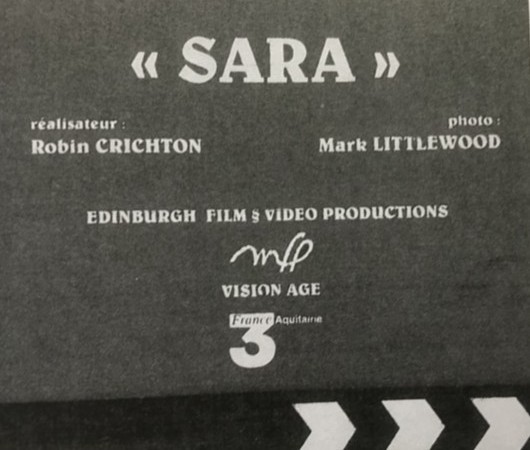
Robin Crichton was one of Scotland’s most enterprising film producers. He had co-written Sara with French writer Brigitte Aymard and It was to be a major international feature film for television; all shot on location in the Camargue region of Provence.

Robin asked me if I would direct the photography for him. At first, I was hesitant. I was always saying goodbye to the people I loved the most and this was for three months. Eventually I was persuaded I knew the homesickness would be there, it always was – but this was a wonderful opportunity to work with the French film industry.

Robin had advised me that he and I would be the only English-speaking people on the production. The camera crew,production and electrical department would all come from Bordeaux they were being supplied by one of the French co-producers. Very few had any English, but all wondered why they didn’t have their own French, director of photography. However, after a few teething problems the creative culturesof Scotland and France blended once again for the benefit of both.

So, here I was for the next three months, filming in the most beautiful place on earth, in the most wonderful light, with the most wonderful people, being served with the most wonderfullocal culinary delights of Provence and drinking the best wine.But homesickness was no respecter of locations.
                                                                                                            P 2

I was reminded of how different this was from the three months I’d spent in the ugliest place on earth. Battered by gale force winds, assaulted by ear shattering demolition, as I carried my food from the catering truck to the broken-downbus, parked amongst the freezing wastes and derelict wharfs of the Isle of Dogs.’ Jellied Eels, Pie and Mash and Brick Lane bagels were amongst the local culinary delights of the East End; washed down by a cup of builder’s tea if therampaging pie-dogs hadn’t already knocked the urn over. I was filming ‘Prospects’ for Euston Films.

Anyway, back to Provence.

To be cont. in (blog 2)

SARA is in my book “Shaping the Shadows: A PictureMaker’s Story” along with many others and is on sale from the National Library of Scotland for £10.

Also available from:

marklittlewood.org.uk

Amazon

#Prospects #RobinCrichton #SaintesMariesdelaMer #Sara#nationalLibraryofScotland.

2025-09-18T08:15:08+00:00NEWS/BLOG|

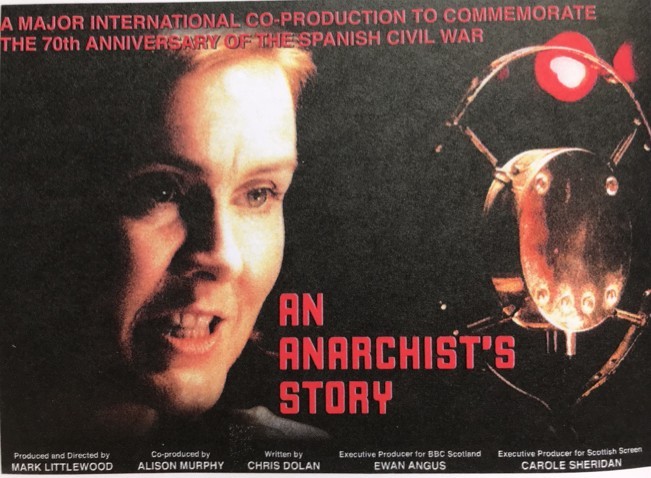
An Anarchist’s Story (blog 2)

Dead babies lying randomly like rag dolls, beside the mutilated bodies of their dead parents. Rows of men lined up against a wall and shot. 

B/W archive  footage shot by the news war cameramen, was by far the most compelling way to show these Spanish Civil War atrocities (1936-1939)


Making the Ethel MacDonald film was a real challenge for me because I was unsure how to use my own visual interpretation of this complex story. My films rely heavily onEvery Picture tells A Story” But I wasn’t very good at carnage;  so, without Alison, Chris and Andy I would have found it even more difficult .


There were numerous sets of initials representing differentfactions, even on the same side. But I wasn’t the only confused one. George Orwell, unlike all the otherinternational, volunteers  joined the P.O.U.M., instead of the ‘International  Brigades’ – Noam Chomsky thought this unique. The difference between two sets of initials could mean life or death.


Chris’s writing and Spanish experiences helped:

‘Although period by nature the film should capture the fresh and quirky look, reflecting the youthfulness and vivacious of its central character – further emulating the style and tone of 1930’s Spain. This look would be helped by following Ethel’s journey from the cold Scottish industrial landscape to the heat and colour of the Spanish Mediterranean – and to the distinct idiosyncratic character of Barcelona itself. The compelling colour of Ethel’s new world will be enhanced even further by revolutionary artwork and propaganda in the overall flavor of the mix/confusion of the Spanish Civil War. This will be balanced by gripping archive film – never shown on screen before – and stills providing testimony to our heroine’s activity. The definitive blend of slow Catalan melodies, protest and anarcho-punk musical styles will provide an exhilarating soundtrack to the film, enhancing the dualism of gritty documentary and emotive drama’.


Earlier BBC Scotland had re-entered the funding fray with additional finance; this was to be their flag ship programme to commemorate the 70th anniversary of the Spanish Civil War. Once again, I was tasked with making two versions: one for BBC Scotland, the other for Scottish Screen.


I think we were very successful in telling Ethel’s story, but I’m still haunted by that bloody violence, indiscriminate killing and the great tragedies that unfolded.


Both our international co-productions; the multi-award winning “Orwell: Against the Tide” and “An Anarchist Story”were conceived in Scotland, had their gestation period in Scotland and were produced in Scotland.

I firmly believe the soul can be anchored in the power of hope and optimism when combined with hard work and resilience; remember, talent is 99% graft.


‘An Anarchist’s Story’ is in my book, “Shaping the Shadows: A Picture Maker’s Story

along with many others and is available from the National Library of Scotland at the special student rate of £10.

Also available from marklittlewood.org.uk

Amazon

#ChrisDolan #NationallibraryofScotland #ShapingtheShadowsApicturemakersstory#SpanishCivilWar

2025-09-03T10:15:38+00:00NEWS/BLOG|

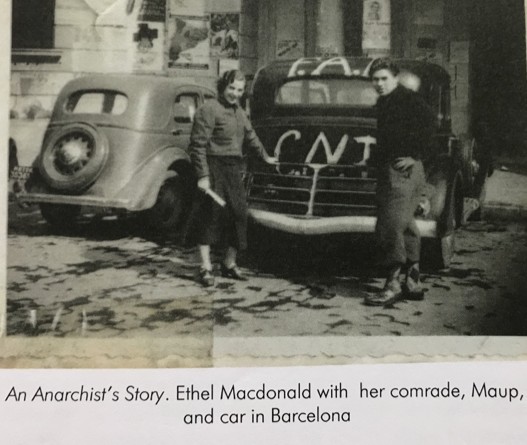
An Anarchist’s Story(Blog 1)

….my room door burst open and three armed men ransacked my lodgings and dragged me to the waiting Tumbril an open cart for transporting condemned prisoners to the guillotine during the French Revolution. Seven charges were fabricated against me my life is in grave danger”                                         reported Ethel to the Sunday Mail: Oct. 1937.

Great Conflicts produce great people; Ethel MacDonald’s impassioned radio broadcasts represented the fulfilment of her longing to ‘serve the struggle        wrote The Glasgow Herald.

Her voice was now becoming famous round the world, even inHollywood, California, but was less known in her hometown ofBellshill, Lanarkshire. Ethel left there at the age of twenty-seven, to go and fight in one of the bloodiest conflicts of all time. The Spanish Civil War.

Many of the British volunteers killed in the ‘International Brigadesduring this war, were Glaswegians. It was a time of economic depression, hunger marches and the rise of fascism. Franco was supported by the fascist regimes of Hitler and Mussolini, against the left-wing republicans, supported by the International Brigades, Soviet Russia and U.S.A.

Because of her reports back to the Scottish press, Ethel was accused of spying, which placed her in mortal danger. Blacklisted by the Spanish authorities and under constant surveillance from Stalin’s secret police, she became known as the ’Scots Scarlet Pimpernel’

. I was sitting in a café and a face that seemed strangely familiar,asked me if I was Ethel MacDonald. As I said ‘yes’ I suddenly recognised him as one of the men who had arrested me.                                                               Reported Ethel to the Evening Times: 27th. Sept. 1937.

Ethel’s story ranks with those of other war heroines, such as La Pasionaria and Odette. It was discovered by Scottish Screens FactualTrainee, Alison Murphy, whilst researching for my George Orwell filmin Glasgow’s Mitchell Library.

Alison had started working with me on ‘Orwell: Against the Tide’ while completing her internship under the guidance of Kay Sheridan, Scottish Screen’s New Entrants administrator. She then went on to co-produce ‘An Anarchist’s Story. 

Another essential was the multi-talented author Chris Dolan, who subsequently wrote the book and from whom many ideas came. Finally,Andy Boyd, my great redeemer and ever-present editor completed theteam. 

Before I continue further with Ethel, I’d like to tell you how this film came about in my first blog and more about how it was made in my second.

Following the success of ‘Orwell – Against the Tide’ the European Commission’s department of ‘Education and Culture’ awarded us development funding for another three major international co-productions, all feature drama/documentaries. The only slate funding they commissioned that year.

So, we had development funding, but no production funding. Once again, I began my trek round Europe with my begging bowl. Jordi Ambrose, true to his word, returned with TV Catalunya, as did the ‘Institute Catala des les Industries Culturals’, along with our knew Spanish co-producer, La Productora, Scottish Screen, BBC and STV.

Follow this story in my 2nd. blog and in my book, Shaping the Shadows: A Picture Maker’s Story, along with many others. Available from the National Library of Scotland at a special student price of £10.00 Also available from marklittlewood.org.uk and Amazon.
#ScottishScreen #ChrisDolan #OrwellAgainsttheTide #ShapingingTheShadows.

2025-08-27T14:51:24+00:00NEWS/BLOG|

From ‘Film Bang’ to filming boom(N.L.S.)

From ‘Film Bang’ to filming boom(N.L.S.) This was a significant and well-chosen period to review.

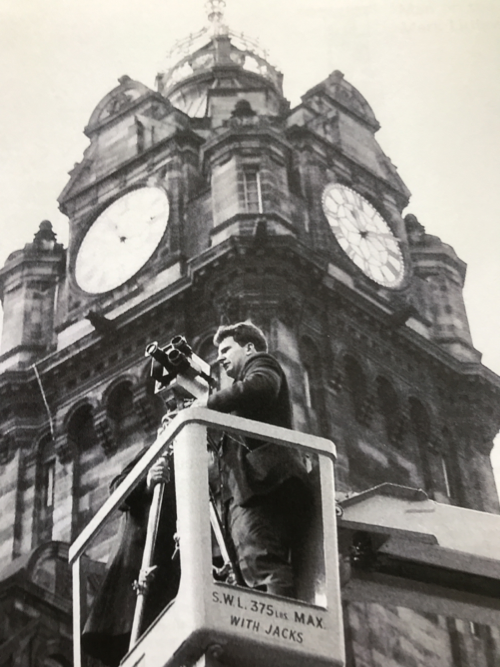
I know because in 1964 I had the good fortune to become thetea boy at Campbell Harper Films in Edinburgh. I was alsopriviledged to be the only person with his name in both the first Film Bang(1978) and the current edition(2025).

During the late sixties I made a self-funded film called ‘Beneath the Skyline – Edinburgh to Music whilst attending Napier’s inaugural evening classes in still photography.

This was really my rookie effort, but it became legendary when the BBC chose Beneath the Skyline to show off Edinburgh’s magnificence to the world. So, my impressionistic, self-funded vision of the city opened the Eurovision Song Contest’ when it was broadcast from the Usher Hall in 1972.

BBC audience figures showed that my wee apprentice piece had been seen by over four hundred million people.

See excerpt: 1967/8 ‘Beneath the Skyline – Edinburgh to Music at marklittlewood.org.uk

Also see: https://www.youtube.com/watch?v=9sN_V_uDjd0

Forty-four years passed before I reached another milestone.B.A.F.T.A. Scotland presented me with their award for ‘Outstanding Contribution to Scottish Film. 

See these stories and others in:

‘Shaping the Shadows: A Picture Maker’s Story’ on sale from:

The National Library of Scotland,   marklittlewood.org.uk   and Amazon.
#CampbellHarperFilms #NationalLibraryofScotland#filmbang #BeneaththeSkyline:EdinburghtoMusic#NapierUniversity #ShapingtheShadow’s:APicturemaker’sStory.


2025-07-30T13:19:43+00:00NEWS/BLOG|

A HIGHLAND EMPIRE

Two hundred years ago, the struggle for fur-trade supremacybetween the Northwest Company and The Hudson Bay Company became Gael against Gael. The HBC’s Earl of Selkirk had a dream of settling Canada’s wilderness with immigrant Gaels, cleared from their Sutherland crofts.

The Gaelic goodfellas of the NWC – grandsons of Culloden losers, transformed by their Mafia-like instincts and the muscles of their canoe brigades into millionaire Lords of the forest had other ideas.

The future of Canada was at stake …. wrote Douglas Eadie.

Douglas’s ability to write tempting proposals was legendary.

The Gaelic Broadcasting Channel MG Alba has always been a positive force for good and on this occasion they shared the funding of ‘ A Highland Empire with BBC Scotland.

This curious way of funding provided a unique challenge for me as Director. I had to make two feature documentaries at the same time, about the same subject, but in two different languages. One in Gaelic Iompaireachd nan Gaidheal witha presenter (Iain MacPherson), the other in English – the presenter having been replaced by the wonderful actor Kevin McKidd narrating the story, one with subtitles, one without.

Andy Boyd my fabulous editor who had made such a significant contribution to our ‘Orwell: Against the Tide’ film was once again called upon to construct remarkable cohesion out of my visual excesses, add to that Jamie and Dougie MacLeans original music and you have two compelling films for the price of one. Not quite, but it was possible to make substantial savings.

Making films is a wonderful team effort and I enjoyed making another five for the Gaelic Chanell. I was also fortunate enough to direct the photography on their first ninety minute feature film, ‘As an Eilean (From the Island) directed by my Pelicula Films partner, Mike Alexander and co-written by Dolina MacLennan and Douglas Eadie.

#earlofselkirk #immigrantgaels #Orwellagainstthetide #mgalba

# lompaireachdnangaidheal #ahighlandempire 

This story and many others are available in my book:

‘SHAPING THE SHADOWS: A Picture Maker’s Story’ available from the National Library of Scotland:

http://shop.nls.uk/shaping-the-shadows-2798-p.asp

marklittlewood.org.uk

Amazon

2025-07-22T10:11:42+00:00NEWS/BLOG|
Go to Top