The Moscow Olympics No Easy Way: ALLAN WELLS, One Man’s Olympics (1978-80)
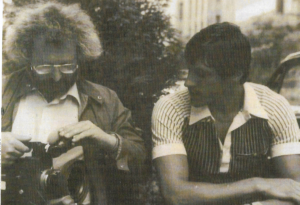
Mark Littlewood and Allan Wells

Mark Littlewood and Allan Wells 


Following the success
of our Jenkins film Mike and I decided to make another in-depth sports film. This time about a sprinters preparation for and participation in the blue-ribbon event, the 100 meters at the Moscow Olympic Games.

Despite Pelicula’s pedigree and vision, already demonstrated at the 1976 Montreal Olympics, the established broadcasters still refused to recognize independent film production, so we set out once again, to self-fund No Easy Way.

My continued work with Occidental Oil and B-CAL meant that Pelicula was able to invest in its own camera equipmentand this was beginning to pay dividends in our inclusive, self-help environment.

We thought Allan Wells had the potential to win a Gold Medal. He trained with his wife Margo, also an internationalathlete, so a family film story beckoned.

After explaining to Allan and Margo the kind of film we had in mind both agreed to let the Pelicula team shadow them for the two years leading up to the 1980 Moscow Olympics. We travelled round the world together, filming training and track events in New Zealand, Australia, the Cote d’Azure and Edinburgh.

During one of Allan’s Training sessions, in the pouring rain at Meadow Bank Stadium Edinburgh, we discussed how best tofilm his explosive start and convey the impression of speed.Allan was also keen to have this on film.

It was agreed that we would position our camera car in the lane next to him but start much further back so that we were up to speed by the time we drew level with him in the starting blocks. He then had to time his start to co-inside with the camera car as it drew alongside. I was sitting in the back of aVolvo estate with a high-speed camera. After a few trial runswe got some remarkable slow motion footage of Well’s exploding from the blocks, every muscle and sinew bulging with maximum effort. We kept level with his sunken cheeks the impression of speed phenomenal.

Once again, our perseverance and hope had got us far, but the lack of external funding was beginning to tell and that wasn’t the only challenge facing us; we still had to get our small teaminto Russia to film the games.

Shortly before Mike and I left for Russia the late David Scott, then Programme Controller at S.T.V. offered us a generous amount of co-production funding. Later, this would have repercussions when the A.C.T.T. shop steward at S.T.V.,refused to broadcast the completed film. This not only shows the attitude of the staff within the established broadcasters towards independent producers, but also their ability to prevent them from earning a living. Channell 4 was not yet invented.                                                                                                                            

These were dangerous times. The cold war between Brezhnev’s Russia and the West was reaching new heights of tension after the Russian invasion of Afghanistan in 1979, theIron Curtain still very much in place.

Undeterred, Mike and I set out alone, filled with hope and trepidation to recce Moscow and see if the Russians would let us bring our small Pelicula team into film the 1980 Olympic Games. The Americans had already protested by boycotting the games, along with several other countries, For the same reason Maggie Thatcher put pressure on Wells not to compete, but he ignored her and thereafter refused all media requests for an interview, accept with Pelicula Films. 

The Russian security, then ruled by the K.G.B., could copewith teams of officially organized broadcasters, but they were very distrustful of small groups or individuals travelling alone. Both Mike and I were certain that our home phones had been tapped after we applied for visas and were expecting to be thrown into the Lubyanka at any moment.

As it turned out, when we came to film the Games a few months later, the stadium officials couldn’t have been more helpful and in exchange for a typewriter they assured us that we would be given a prime spot from which to film AllanWell’s races.

Much to our delight Well’s won the 100 meter Gold Medaland the 200 meter silver medal. Naturally after these victories he was surrounded by the world’s press, but he and Margopreferred to travel back to the hotel with us.

It was fascinating to be so close to an athlete that has just wonOlympic Gold and Silver. Mike and I both noticed that Wells’s whole demeanor had changed from the tense, tight, determined face we had, for two years become accustomed to,to a calm, serene happiness we’d never seen before – what a priviledge.

Some thought Well’s triumphs in the Olympics were dilutedby the American boycott. However, within 14 days of his Olympic success he accepted an invitation to a showdown meeting with America’s fastest 100 meter athletes, includingCarl Lewis in Koblenz, Germany.


The Americans were expected to win, but Wells beat them all in a speed of 10.19 seconds. His credentials were never questioned again and he remains the last white athlete to win a 100 meter Olympic Gold Medal since

In 2002 Olympic Gold Medal winners Allan Wells and Eric Liddell were the inaugural inductees to the Scottish SportsHall of Fame.


Eric Liddell’s Olympic Gold in the 1924 Paris Olympics, made famous by Lord Puttam’s production Chariots of Firewill be commemorated at this year’s 2024 Paris Olympics.

                                                                                                                                                                                                      3

There has only been one other Olympic Gold Medal awarded to a Scot, in track and field, since Liddell’s triumph in Parisand that is the one won by Allan Wells in Moscow, made famous by the Pelicula Films production No Easy Way’,                                                                                                                                

Allan and Margot Wells continued their successful coaching careers, pausing only to raise their two children, Zoe and Simon

In 2014 they both received Hon. Doctorates of Science from Edinburgh’s Napier University. Napier was also the first placeI studied photography.


#No Easy way: Allan Wells, One Man’s Olympics (1978-1980) #Blue Riband  #Pelicula’s Pedigree #Pelicula’s vision#estabilshed broadcasters  #Occidental Oil  #B-CAL Airways #selffunded  #selfhelp #hope  #challenge  #high-speed camera  #exploding  #cold war  #Brezhnev’s Russia # iron curtain  #Margaret Thatcher  #trepidation  #Recce Moscow #Russian security  #K.G.B  #Lubyanka  #Prime spot  #Well’s 100 meter gold  #Wells’s 200 meter silver  #American boycott.  #showdown meeting #Koblenz  #Well’s victory over America’s fastest 100meter runners #Eric Liddell, gold medal Paris Olympics 1924  #inspired the film Chariots of Fire. #commemorated at Paris Olympics 20024  #Wells only other white man to win a 100 meter gold medal, in track and field since Liddell.

2024-08-05T08:51:46+00:00NEWS/BLOG|

The Long Sprint: Diary of an Olympic Athlete

INNOVATION:
Developing Something Different – Independently
The Long Sprint: Diary of an Olympic Athlete (1975-76)
David Jenkins was already a multi medal champion, winning gold in both the Commonwealth and European Games. Going into Olympic Year he was the worlds No1 over 400 meters – The Long Sprint. His coach David Hemery (MBE) had already won Gold in the 1968 Mexico Olympics (400 meter hurdles).

Our self-funded film, made over two years, explores the intimate relationship between athlete and coach as they prepare to compete in the 1976 Montreal Olympic Games.

This was to be a film that would revolutionize the making of Sports Documentaries. Pelicula was forging new ground, challenging the big broadcasters’ autocracy, with a new and different kind of ‘in-depth’ sports film. The BBC started to make this type of sports documentary almost 50 years later with their excellent award-winning stories about Marcus Rashford and Rob Burrow which were called ‘Authored’ Documentaries.

The idea was that a non-intrusive, in-depth approach to filming sports men and women would, not only achieve better understanding of their sport for the viewer but would also enable a more intimate camera to reveal maximum effort. To achieve this, we would have to spend a lot more time getting to know the athlete personally, always turning up with the same crew and gradually earning their trust, respect and confidence.

An Olympic athlete is a high-performance individual and it’s essential to familiarize them with the same camera and crew. At this time elite athletes were used to television staffers turning up, but only when they were newsworthy and then being asked to perform like seals. The commentary would be spoken by a disembodied voice, again removing the viewer even further from reality.
So, our film would have no commentary, only the athlete’s words, spoken either in (voice over) or (directly to camera) telling us about their lifestyle, motivation and commitment.
The challenge for us was to shift the emphasis from a television-led situation, to an athlete-led situation, whereby the athlete described the reality of his/her own situation directly to the TV audience, making it more personal, informative and entertaining.

At this time I was also filming for the ever expanding airline British Caledonian Airways(B-CAL) and my agreement with them to fly me and my crew anywhere in the World, came in handy when David and David decided to train on the Campus at the University of California, Los Angeles (U.C.L.A.)
2)
I was also filming for Occidental Oil who were about to discover one of the biggest oil fields in the North Sea, Piper Alpha. Meanwhile Mike continued to hone his writing skills.

My work for B-CAL and Occidental Oil provided the funding which Mike and I (Pelicula Films) decided to commit to ‘The Long Sprint.’
As usual the established broadcasters refused to support our idea so we were always operating alone, without any financial or facilities support. So this would introduce some very scary moments.

I was stuck in the Liberian office of B-Cal waiting for them to confirm my flight to Montreal. Naturally at Olympic Games time all flights were full; however, they found me a seat on a flight to Toronto in the cockpit, behind the pilot. I’d sat there on several occasions during my filming assignments for the airline, so I was quite happy.

For me to operate freely within the airline, B-Cal had made me a senior member of staff with high priority. This seemed funny at the time, but it was incredibly helpful and as the plane landed, I thought all my worries were over.

I was going out early to join Mike and film the build-up to the games before the rest of the crew arrived. But I became enmeshed in yet another crisis which threatened to demolish our whole independent operation.

Because of my relationship with British Caledonian, I always carried a list of my camera equipment on their Letterhead, saving time and money when we entered another country and this method was accepted by the customs worldwide. However, because of the Games heightened security, Toronto customs refused to accept my documents and impounded all my camera equipment. And I needed to film the next day.

They weren’t unfriendly, but they were very firm and told me the best thing they could do was put the equipment, ‘In Bond to Air Canada’ and fly it to Montreal, where I could continue my pleading with the Montreal customs. They then proceeded to wrap all my camera cases in bright red sticky tape with yellow lettering.
So, I boarded a domestic Air Canada flight and as I stood waiting forlornly at the carousel in Montreal to collect my personal luggage, to my surprise all my camera equipment came off the same flight and because it was a domestic flight there were no custom offices present. The other passengers were astonished when they saw this rather bedraggled individual ripping all the official looking red tape off the cases and putting them on a trolley. There was so much sticky tape that it was still dangling out of my pockets as I left the airport, expecting the shouts of Canadian customs to echo through the departure area.
3)

However, Mike had come to meet me and we bundled all the cases into the car and made our getaway into the city, the bright red tape with the yellow lettering on it still saying, ‘In Bond to Air Canada’ trailing behind us.

David Jenkins came 7th. in the 400 meter final, but amazingly our self-funded Film, ‘The Long Sprint’ about a loser, came first in the 2nd. British International Sports Film Festival, so Jenkins was able to claim Gold after all. This also confirmed the success of our method of making in-depth Sport’s Documentaries.

‘No Easy Way’ our next Olympic Games film about Allan Wells winning gold and silver at the 1980 Moscow Games, despite Maggie Thatcher’s attempt to boycott them and Brezhnev’s secret police attempt to put us in the Lubyanka. I will give a full account of this challenge in my next blog.

My book, ‘Shaping the Shadows: A Picture Maker’s Story’ is also for sale on- line at The National Library of Scotland and on Amazon.
http;//shop.nls.uk/shaping-the-shadows-2798-p.


#Innovation #Independense #motivation This #committement #In-depth #self-funded #sports documentary #challenging #BBC #established broadcasters #television led #athlete led #The Long Sprint: Diary of an Olympic athlete #1976 Montreal Olympics #High performance #Elite athlete #David Jenkins #David Hemery, #scary moments #Liberian office, #trust, respect, confidence #informative #entertaining #Marcus Rashford #Rob Burrows. #British Caledonian Airways #Occidental Oil.


2024-07-24T21:51:14+00:00NEWS/BLOG|
Go to Top