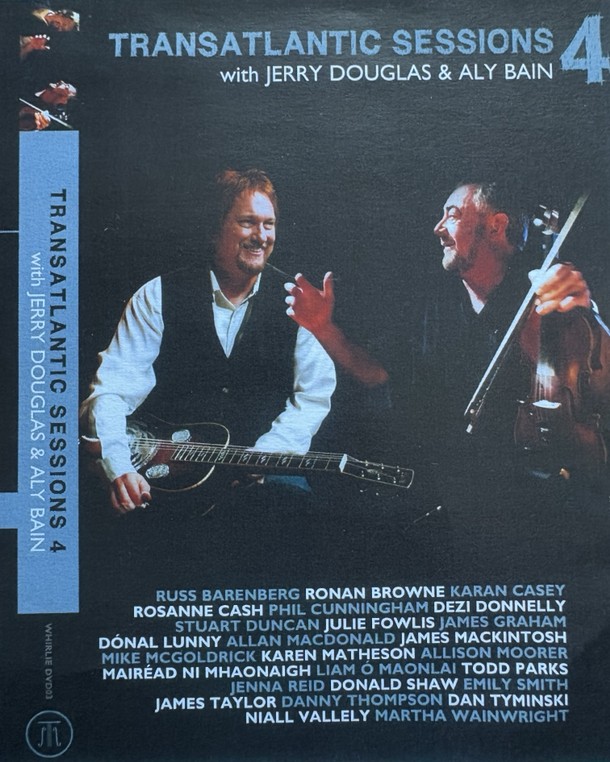
TRANSATLANTIC SESSIONS: Black is the colour I usedmost when lighting ‘Transatlantic Sessions’. It’s a great tool when you’re trying to conceal multiple shadows.
‘Transatlantic Sessions’ is a wonderful music series brought to Pelicula Films by its director, the late Mike Alexander.Pelicula was formed by Mike and I in 1971, and here we were in 2012, still making films. The ‘Transatlantic Sessions’ series was re-commissioned on six occasions and I was fortunate enough to direct the photography on all thirty six episodes.
Mike’s ability to co-ordinate the musicians on a set, sometimes as many as nine, was legendary and they produced a fabulous sound. According to all accounts the pictures were pretty good too.
Mike would first decide, along with his three camera operators, where the best angles were, not only to film the musicians, but also the scenic magic of Loch Lomond seen through the glass windows behind them. So now we introduce a plethora of reflections, along with the varying intensity of daylight on the other side of the glass. To control the intensity of the outside daylight, constantly changing from bright sun,to moody black clouds; Derek Ritchie, my gaffer sparks made up three frames to fit each window, enabling us to use different grades of neutral density filters to balance the outside daylight with our inside artificial light.
I invented black key lights to hide the numerous invasiveshadows that naturally appear when lighting the six musiciansin the House Band. There’s also microphones and mic stands, to contend with, all on a cramped set. The sound engineerscreated miracles with the quality of sound they produced frompencil thin mics.
I’m starting with a black canvas and I need six lights permusician to create the pictures that will highlight for the viewer, the intricate skills and wonderful performance of eachartists. Only trouble was that thirty-six lights have the potential to create thirty-six shadows.
Of course, the black key lights didn’t exist, only in my imagination, but it enabled Derek and I to work out a lighting plan where the shadows would be concealed in the black spaces we created round the artists, using every lighting control available.
At the risk of attracting complete boredom, let me tell you why I need six lights per musician.
For Aly Bain plus fiddle, I’d have a back key light focused on his bowing hand and another back key light on his fingerboard. I would then have a three-quarter back key lightto shape his face and a fourth back light to separate him from the background. These were all positioned first. I would then introduce my soft fill light to see Aly’s face and a soft upwardfloor light to lessen the contrast overall.
What a privilege. Apart from the wonderful House Band, I was lighting such eminence as Emmylou Harris, James Taylor, Alison Kraus, Dougie Maclean, Dick Gaughan, Iris DeMent, Rosanna Cash, Nancy Griffith, Rufus Wainwright,Mary Chapin Carpenter, Julie Fowlis, Allison Moore, Teddy Thompson, the late John Martyn and many more.
So, I called my memoir, ‘Shaping the Shadows: A Picture Maker’s Story’.
Available from the National Library of Scotland(£10)
marklittlewood.org.uk
and Amazon.